Article Why a powerful brand is important in B2B

Branding is essentially the process to build and maintain an identity. It is a key process in marketing but also touches on practically every area of a business. Effective branding represents your company’s DNA, is inspirational, engages your stakeholders and makes you stand out from competitors. It is a key ingredient when it comes to the recipe for success and it is equally important for small and medium-sized businesses as for large enterprises. A corporate identity that matches the values of your customers and employees generates recognition, familiarity and trust, all of which are important elements in business success.
Jeff Bezos, CEO of Amazon once said: “Your brand is what people say about you when you’re not in the room.” This very well summarizes what branding is about: the perception of how your stakeholders experience your brand, connect to it and appreciate it (or not…). Bezos’ statement makes clear that branding is about who you are as a company and how you establish an emotional connection to the values of your stakeholders.

Find your purpose
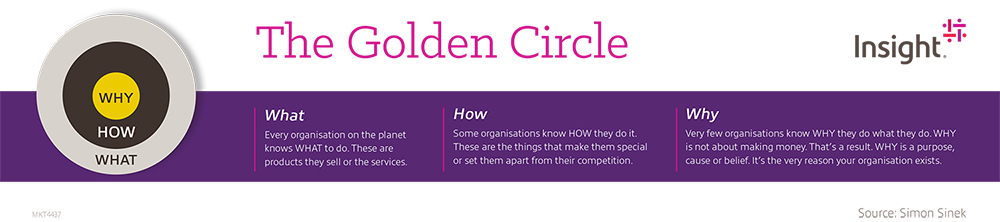
A good starting point for building a brand is to define the purpose of your company: why do you exist? A useful tool in this respect is what Simon Sinek, in a well-known TED Talk, refers to as the Golden Circle. Through the “Golden Circle” Sinek introduces the 'inside-out' approach. In other words, if you want to find your purpose, you have to look from the inside and out. Look within and ask yourself why does your company exist? Sinek's message is simple: people do not buy what you do; they buy why you do it. The second question to ask yourself is how your company demonstrates its values and finally, what are the products and services that those represent.
Emotional Connection
Once you have defined the ‘why’ for your company, you can work on a powerful brand mission statement and establish an emotional connection with your stakeholders. Keep in mind that the mission should be at the core of your business and lead in everything you do. There are several ways to build an emotional connection with your stakeholders. Focus on what it is that makes your company unique, the values that you represent and how you can demonstrate those. Look beyond the products and services you are offering and think of key values you align with. Is quality, sustainability, giving back to certain communities, diversity or equality more important to you? Once you have established your key values, you'll be able to engage and inspire people by demonstrating how you represent those.
One example of how a company use their underlying values to connect to its audience is Amazon Smile, where Amazon donates a percentage of each purchase to a charitable organization. Another one is Warby Parker´s “Buy a Pair, Give a Pair” program that donates one pair of glasses to someone in need for each pair of glasses purchased. Nike, is another example, whose answer to the ‘why’ is to bring inspiration and innovation to every athlete in the world (with the addition that “if you have a body, you are an athlete”).
How does this then translate to B2B?
The general perception is that branding is primarily important in business-to-consumer (B2C) relationships and less in business-to-business. However, it is often forgotten that behind every B2B company there are people who make decisions and behind every B2B customer there are people with emotions who prefer to do business with companies that share their values. There is a unique opportunity for B2B companies that want to compete and grow by building a strong, distinctive brand. Define your ‘why’ and start engaging with your target audience.